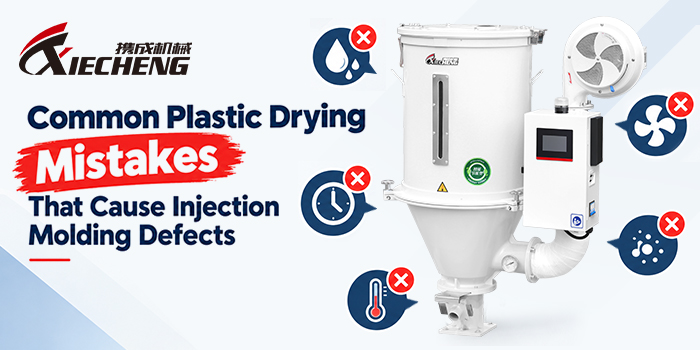
In injection molding, the drying quality of engineering plastics directly affects the performance and stability of the final product.
Unlike general-purpose plastics, hygroscopic materials such as PA, PC, and PET absorb moisture from the air during storage and transportation.
If drying is insufficient, residual moisture can cause defects during the high-temperature melting stage. This makes low dew point control a key parameter in engineering plastics drying systems.
What Is Low Dew Point Control?
Dew point refers to the temperature at which water vapor in the air begins to condense into liquid. It is one of the most important parameters used to measure the dryness of air.
The lower the dew point, the lower the moisture content in the air, and the greater its ability to absorb moisture from plastic materials.
In engineering plastics drying applications, the dew point of drying air usually needs to be controlled between -30°C and -40°C, or even lower. Only under such ultra-low humidity conditions can moisture inside plastic pellets migrate effectively to the surface and be removed.

This is why modern dehumidifying dryers and desiccant drying systems are widely used in injection molding plants where precise moisture control is required.
Why Is Low Dew Point Important for Engineering Plastics Drying?
Moisture trapped inside engineering plastics can cause hydrolysis reactions under the high temperatures of injection molding, which break polymer molecular chains and significantly reduce the material’s mechanical properties.
Typical defects caused by insufficient drying include:
· Splay (silver streaks)
· Bubbles
· Rough or uneven surfaces
· Dimensional instability
· Brittle finished products
In many cases, these defects are mistakenly attributed to the mold or injection molding machine, while the actual cause is insufficient moisture removal during the plastic drying process.
Only when stable low dew point drying air is continuously supplied can the moisture inside hygroscopic plastics be fully removed, ensuring consistent processing quality.
Why Traditional Plastic Dryers Are Not Enough?

Traditional plastic dryers or hopper dryers mainly rely on heating air to evaporate moisture from the material. However, this method cannot significantly reduce the moisture content of the air itself.
When processing hygroscopic engineering plastics, simply increasing the temperature often leads to surface drying while internal moisture remains trapped inside the pellets. This phenomenon can result in unstable product quality during injection molding.
In contrast, dehumidifying dryers and desiccant dryers first remove moisture from the air before heating it, creating ultra-low dew point drying air. This greatly improves moisture migration efficiency and ensures deeper, more reliable drying.
For this reason, modern injection molding plants increasingly adopt hopper mount dryers, insulated hopper systems, and centralized plastic drying machines integrated with dehumidifying dryer technology.
Why Stable Dew Point Matters More Than Instant Low Values?
In real production environments, reaching a low dew point momentarily does not necessarily mean the drying system is effective.
Engineering plastics often require several hours of continuous drying. If the dew point fluctuates significantly during this process, the material may reabsorb moisture, leading to inconsistent product quality.
Therefore, long-term dew point stability is far more important than achieving a temporary low dew point value.
XIECHENG Dehumidifying Dryer Solutions for Engineering Plastics

To meet the strict drying requirements of engineering plastics, XIECHENG Dehumidifying Dryer series are designed to deliver stable, efficient, and energy-saving plastic drying solutions.
1.Stable Low Dew Point Performance
XIECHENG systems utilize high-efficiency honeycomb desiccant rotor technology, enabling stable -40°C class low dew point air output. This ensures reliable deep drying for hygroscopic materials such as PA, PC, PET, and other engineering plastics.
Note: Low dew point air is generated by the dehumidifying unit. The dryer itself provides heating and air circulation.
2.Optimized Hot Air Circulation
The system adopts a specially designed hot air diffusion and circulation structure, allowing raw materials inside the hopper to be heated evenly. Combined with an insulated hopper design, this improves thermal efficiency while maintaining consistent low dew point drying performance.
3.Dew Point Monitoring System
A high-precision dew point meter can be optionally installed to monitor the drying air condition in real time.
The dew point value is displayed through the microcomputer controller, allowing operators to monitor system performance and adjust parameters according to actual production requirements. This improves the controllability and stability of the entire drying process.
Note: The dew point meter is an optional monitoring device used to observe the drying air condition.
4.Flexible System Integration
The XIECHENG dehumidifying dryer series It can be integrated with a centralized material conveying system to form a complete injection molding auxiliary solution, improving overall workshop energy efficiency.
Choose a dehumidifying and drying system from XIECHENG to continuously enhance your competitiveness in high-end engineering plastics processing!