In the injection molding process, proper plastic drying is essential to ensure product quality and stable production. Many thermoplastic materials absorb moisture during storage and transportation.
If these materials are processed without adequate drying, the residual moisture can lead to injection molding defects, reduced mechanical properties, and inconsistent product quality.
Understanding which plastics require drying before injection molding helps manufacturers select the right plastic dryer, optimize process parameters, and improve production efficiency.
Hygroscopic Plastics vs. Non-Hygroscopic Plastics
Plastics used in injection molding are generally divided into two categories based on their moisture absorption characteristics: hygroscopic plastics and non-hygroscopic plastics.
Hygroscopic Plastics
Hygroscopic plastics absorb moisture into their molecular structure. This means water is not only present on the surface of the pellets but also inside the resin itself.
Because of this internal moisture, simple heating is usually insufficient. These materials require controlled drying conditions, often using dehumidifying dryers, to remove moisture effectively.
Non-Hygroscopic Plastics
Non-hygroscopic plastics do not absorb moisture internally. Instead, water typically remains on the pellet surface, making it easier to remove.
In many cases, simple hot air drying using a hopper dryer is sufficient to prepare these materials for processing.
Common Plastics That Require Drying Before Injection Molding
Many engineering plastics are highly hygroscopic and must be properly dried before processing.

Polyamide (PA / Nylon)
Nylon (PA) is a highly hygroscopic material widely used in:
· Automotive components
· Industrial gears
· Electronic connectors
· Mechanical structural parts
If the moisture content is too high, injection molding may result in surface defects, bubbles, and reduced mechanical strength.

Polycarbonate (PC)
Polycarbonate (PC) is commonly used for:
· Optical lenses
· Smartphone housings
· Electronic device components
· Medical equipment parts
PC is extremely sensitive to moisture. Even a small amount of water can cause hydrolysis during processing, affecting transparency, strength, and dimensional stability.

Polyethylene Terephthalate (PET)
PET is widely used in:
· Food packaging containers
· Preforms for beverage bottles
· Electronic structural components
If PET is not properly dried, the material may degrade during high-temperature processing, which negatively affects clarity and product stability.

Acrylonitrile Butadiene Styrene (ABS)
ABS is widely used for:
· Household appliance housings
· Consumer electronics
· Toys
· Automotive interior components
Proper drying improves surface quality and ensures consistent product appearance.

Polybutylene Terephthalate (PBT)
PBT is commonly used in:
· Electrical connectors
· Sensor housings
· Automotive electrical components
Due to its moisture sensitivity, strict drying conditions are usually required to maintain dimensional stability and electrical performance.
Plastics That Usually Do Not Require Strict Drying
Some commodity plastics are less sensitive to moisture and typically do not require complex drying processes.

Polypropylene (PP): Commonly used for food containers, bottle caps, and automotive interior parts. It is generally insensitive to internal moisture, though light preheating may help remove surface moisture in humid environments.
Polyethylene (PE): Widely used in pipes, films, shopping bags, and plastic crates. PE typically does not absorb moisture, but mild drying can improve processing stability when producing high-clarity products.
Polystyrene (PS): Often used for appliance housings, toys, disposable tableware, and electronic casings. It has low hygroscopicity, and any surface moisture can usually be removed with simple hot-air drying.
The Importance of Plastic Drying Equipment
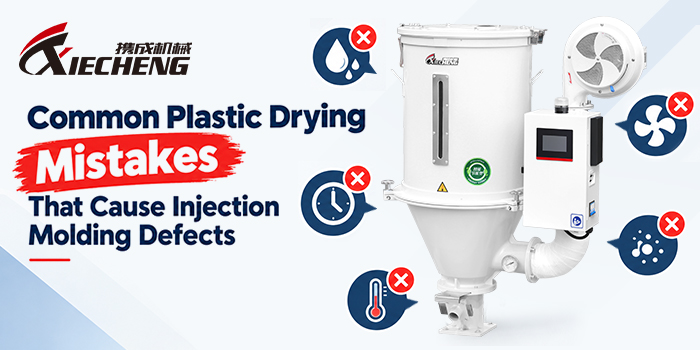
To ensure plastic materials reach the proper moisture level before processing, many injection molding factories use professional plastic drying equipment.
XIECHENG drying systemscover a complete range of solutions, including:
· Hopper Dryers
· Dehumidifying Dryers
· Hot Air Plastic Dryers
These systems can meet the drying requirements of different plastic materials and production capacities.

Advantages of XIECHENG Plastic Drying Equipment
1.Energy Efficiency
Optimized air circulation and heating systems reduce energy consumption while maintaining efficient drying performance.
2.Consistent Drying Quality
Precise temperature and humidity control ensures uniform drying and improves product consistency.
3.Advanced Technology
Modern dehumidification technology and intelligent control systems provide stable and reliable drying conditions.
4.Manufacturer Strength
As a source factory for plastic auxiliary equipment, XIECHENG delivers reliable machines, durable quality, and fast service support.
Choosing XIECHENG drying equipment means choosing stable production, energy efficiency, and reliable product quality—protecting every plastic pellet before it enters the molding process.